
Leak Detection
Hidden leak, rising water bill or damp spot you cannot explain? We find leaks in walls, ceilings, slabs and service lines without tearing everything open.
Leak Detection details
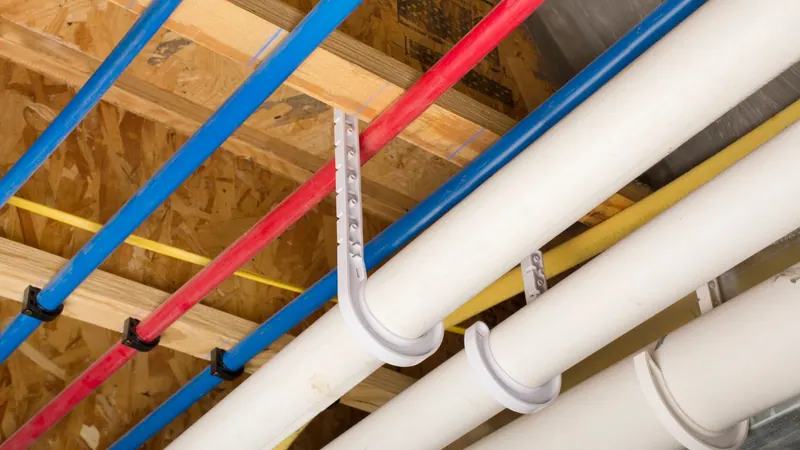
Low pressure, rusty water and leak after leak usually mean old pipe. We replace galvanized and failing supply lines with new copper or PEX, room by room or the whole house.
Quick answer: Look at the exposed pipes in your basement. Galvanized steel is dull gray, heavier looking than copper, and has threaded joints with fittings screwed together. A magnet will stick to it but not to copper. Many Philadelphia homes built before 1950 have at least some galvanized supply pipe. Weak pressure and brown water after sitting are common signs too.
Repiping means replacing the water supply pipes in your home, either a section or the whole house. The most common reason in our area is galvanized steel. Many homes built before about 1950 were plumbed with galvanized pipe, which rusts from the inside. Over decades the inside narrows with corrosion, so pressure drops, hot water turns brown and threaded joints start to leak. Patching one leak at a time gets expensive, and the next leak is often a few feet away. Repiping ends that cycle. New pipe removes the weak points at once.
We replace old supply lines with copper or PEX, running new lines from the main shutoff to the water heater and fixtures. We plan routes that use existing chases and basement ceilings to keep wall openings small. Repiping is also the right time to replace the main shutoff and fixture stop valves. We give you an upfront quote that spells out what gets replaced. If the drain side is also old cast iron, we can camera the stack and lateral so you know where the drains stand. Nothing is hidden in the scope.
We trace the supply lines from the main shutoff through the house, identify pipe materials and check pressure. Then we recommend a whole house or partial repipe, depending on how much old pipe remains and where the problems are. We also look at the water heater connections.
We plan the new pipe routes, choose copper or PEX, and identify where small openings are needed. You get an upfront quote covering pipe, valves, connections and the scope of wall and ceiling openings before work starts. Nothing starts until you approve it.
We run new lines, replace the main shutoff and fixture stops, and connect to the water heater and fixtures. We keep water on as much as possible during the job and restore service each day when we can. Every joint is made carefully.
We pressure test the new system, flush the lines and check every connection. Openings are left clean and ready for patching. We clean up daily and walk you through the new shutoffs when the work is finished. You will know exactly where every valve is.
Philadelphia's rowhome neighborhoods, from South Philly and Point Breeze to Kensington, Germantown and West Philly, are full of homes built before 1950, and many still have some original galvanized steel supply pipe. Even homes that had a bathroom or kitchen redone may have new copper at the fixtures and old galvanized pipe in the basement ceiling feeding it. That hidden galvanized pipe is often why a renovated bathroom still has weak pressure. Brown water after a vacation or first thing in the morning is another giveaway. We see this most in homes where updates were done one room at a time over many decades.
Many older Philadelphia homes also have a lead service line, the pipe that brings water from the street to the meter. The Philadelphia Water Department encourages homeowners to replace lead service lines, and if you are repiping, it is a good time to check what yours is made of. A repipe that stops at a lead or galvanized service line leaves part of the problem in place, so we look at the whole path. We keep the job neat, protect floors and finished surfaces and restore water as often as possible during the work.
Repiping cost depends on the size of the home, the number of bathrooms and fixtures, the pipe material chosen and how accessible the routes are. An open basement ceiling makes runs simpler, while finished walls and plaster need more careful openings. Partial repipes cost less than whole house work. Replacing the main shutoff, fixture stops or service line connection adds parts. We survey the system and give you an upfront quote before any work starts.
Call (518) 776-7838 for an upfront quote. We answer 24/7 and explain the price before any work starts.
No stock photos here. These are our own technicians, our own equipment and real repairs.


We provide repiping across Philadelphia and Bucks, Montgomery, Delaware and Chester counties.
Look at the exposed pipes in your basement. Galvanized steel is dull gray, heavier looking than copper, and has threaded joints with fittings screwed together. A magnet will stick to it but not to copper. Many Philadelphia homes built before 1950 have at least some galvanized supply pipe. Weak pressure and brown water after sitting are common signs too.
If your home has a lead service line, replacing it is a good idea. The Philadelphia Water Department encourages homeowners to replace lead service lines, and PWD has information on programs that may help. You can often see the line where it enters the basement near the meter. Lead is soft, dull gray and scratches to a shiny silver. We can help you check.
Both are good choices. Copper is durable and familiar, and works well in exposed basement runs. PEX is flexible, which lets it snake through walls with fewer openings, and it resists freezing damage better. Many repipes use both. We recommend based on your home's layout, budget and how much finished wall and ceiling we would otherwise need to open.
A partial repipe of one bathroom or a basement run can take a day. A whole house repipe on a typical rowhome often takes a few days, depending on size, fixtures and access. We plan the work so you have water as many evenings as possible. We give you a timeline with the upfront quote so you know what to expect.
If the low pressure comes from old galvanized pipe narrowed by corrosion, yes, repiping usually brings a big improvement. Pressure problems can also come from a failing pressure reducing valve, a partly closed main shutoff, a clogged aerator or a restricted service line. We check those first so you know repiping will actually solve the problem before you commit.
Hidden leak, rising water bill or damp spot you cannot explain? We find leaks in walls, ceilings, slabs and service lines without tearing everything open.
Leak Detection detailsA burst pipe pours water fast. We stop it, repair the line around the clock and check the rest of the run for weak spots.
Burst Pipe Repair detailsOld, leaking or undersized water heater? We remove it, install a properly sized new tank and haul the old one away.
Water Heater Replacement detailsWe answer 24 hours a day, 7 days a week. Call and talk to a real person, or request service online and we will call you back.
Tell us what is happening. Our team usually calls back within two hours. Emergency? Call now, we answer 24/7.
Or call (518) 776-7838, 24 hours a day
